Showing posts with label bats. Show all posts

Saturday, March 17, 2007

A bat named Grosso

Kerry (aka the batgirl) emailed us today to say that they caught a young male bat last night and named it "Grosso." Kerry has been naming the bats in alphabetical order by sex, so Grosso is the 7th male bat. I'm not sure what letter they're on for females, but it was 'E' when we visited a few weeks ago. I actually got to briefly radio track the bat named Carrie. They've been flying through the names (i.e. catching a lot of bats) since we left in December. In two months we only caught Bernie and Carter!

Carrie

Friday, February 09, 2007

A Bat Named Carrie!

For those of you interested in the pine forest bat research saga... It sounds like Kerry has had more than twice as much success catching bats in the past month than she had during the two months we were helping her in Tokoroa! She has been keeping us updated on their successes. Yesterday Kerry emailed us:

"Thought that you night like to know that we captured a young female bat (called Beth) the night after you visited. She smelt of milk still so we assumed that she was still being fed by Mum. we tracked her to a maternity roost - wahoo! Two days later we captured an adult female at that roost using hand nets (i.e. a couple of trout landing nets stuck on some PVC pipe and held up in the air). She too smelt of milk. We named her Carrie. The roost that they are in has 10-12 bats in it each night, so roost emergence counts are pretty exciting!"

Carrie

My Artwork

I drew a picture of a bat for Kerry. We gave it to her when we visited last week after hiking the Tongariro Crossing. I drew it from a photo of Carter in Kerry’s hands and am quite pleased with how it turned out. I think I’m getting better with the pen.


Carrie

Thursday, December 21, 2006

Where has Carter gone?

Tonight was our third night in a row without a beep from Carter. When we got to Carter's favorite road on Sunday, he wasn't at either of his previously known roosts (or more precisely, we did not pick up a signal from his transmitter at the roost sites). We failed to pick up any signal at all anywhere in the area on foot or by driving around, but we did hear him foraging later Sunday night. Monday and Tuesday nights he also went to this unknown roost location and it was raining, so we were not surprised that we didn't hear him fly past his favorite spot. Bats will sometimes opt to stay in for the night if the weather is bad. Tonight, however, was clear. We still didn't hear him. At this point we suspect he may have lost his transmitter in a place where we can't pick up the signal (like at this unknown roost location). Tomorrow night we're going to stake out his two previously used roost sites to listen for bats leaving the roost, since he appeared to be the only bat in those trees last week. We'll see what happens. Hopefully he wasn't eaten by a morepork (NZ owl).

Tomorrow night will probably be our last night tracking (or trying to track) Carter. Then things get REALLY exciting. On Christmas Eve I'm going to Kerry's parents' house and then on Christmas Day we're going to her grandparents' beach house for their big family celebration. I get to experience a real Kiwi Christmas at the beach!

On December 26th I'll drive to Auckland where I'll meet up with two professors from Earlham, Bill Buskirk and Jay Roberts. They're doing a 13-day whirlwind tour of NZ because Earlham is launching a NZ program in Spring 2008! I am SO excited to see Bill because he is one of my favorite Earlham professors and he's writing my letters of recommendation for grad school. I'm going to stay at the Auckland Friends (Quaker) Center with them on Dec. 26th, then pick up Matt at the Auckland Airport at 5 am on my birthday (Dec 27th)! I think Matt and I will celebrate our Christmas together on December 28th. It will be a change to have Christmas and my birthday the other way around. Then we're off to Wellington where hopefully we'll be able to spend a little more time with Bill and Jay before they cross over to the South Island.

Carrie

Monday, December 18, 2006

Adventures in Radiotracking

Since there are probably about 3 people reading this blog who know what radiotracking is like, I thought I should describe it. When we catch a bat, we glue a little radiotransmitter to its back. It has a tiny battery that will allow it to emit beeps every second or so at a certain frequency until the battery dies (about 2 weeks later). We use an antenna attached to a receiver to detect the beeps and thus determine the location of the bat.

The strength of the radio signal is influenced by distance and objects (such as trees) between us and the bat. Bernie foraged extensively along the highway, where we often had a clear 'line of sight' and thus a nice strong signal. Carter, on the other hand, does not forgage much along the road where we caught him and instead forages in a valley with many trees between us and him. When we have a signal for him at all, it's usually weak and difficult to hear.

Radiotracking generally goes something like this: We drive along with the antenna out the window. When we start to hear beeps instead of just static, we stop the car, jump out, and turn the antenna around 360 degrees. As we turn, we determine in which direction the signal is the loudest. Then we take a bearing with a compass and record our position and the bearing to the bat. If possible, we try to move closer to the bat and take another bearing.


This is me using the radiotracking gear to find Carter's roost tree. He has roosted for the day in three different locations and we have been able to find two of them. Both were in dead standing pines quite close to the road where we caught him.

We often lose Carter's signal for minutes at a time. He usually reappears after about 10 minutes without us going anywhere, but if he's gone for much longer than that then we hop in the car and drive down the road to see if he's at one of his roosts.

Last night we were driving along searching in the rain for his signal when we suddenly heard it again. Kerry stopped the car and I jumped out to take a bearing. I landed in a squishy spot and moaned about my misfortune to land in a muddy spot along the road. The Carter's signal was really strong and it sounded like he was quite close to us and actually flying down the road. I stepped aside to take the bearing when I smelled something terrible. I looked back at where I had been standing and saw a big pile of entrails writhing with maggots! Of all the places to stop along the road, I had stepped smack in the middle of a three foot (1 m) wide mass of possum guts. It smelled so foul.

Possum trappers can get permits to trap in the forest. Then they pluck the fur to sell to textile manufacturers or sell the skins. A few days ago we met a possum trapper who'd set heaps of traps down this particular road. I'd stepped right into his gutting pile where he'd dealt to all the possums he trapped.

Carrie

We Had Ourselves a Merry Litlte Picnic


On Saturday night Kerry and I had a dessert picnic at our radiotracking site. We have to get to the site before dark in case Carter has changed roosts, but if he hasn't then we have plenty of time to stand around waiting for it to get dark. So, we thought cheesecake would be a good way to pass the time.


A stick insect also came to our party.

Carrie

Ana Bat


We decided to posthumously name the female bat Ana Bat. Kerry thought it would be better to start over at A for the females because then you can quickly tell how many males and females have been caught/found. We're calling her Ana Bat because Anabat is the name of a fancy bat detector, and we don't know anyone named Ana Bat.

Carrie

Friday, December 15, 2006

D for Dead :-(

Unfortunately, the unnamed 'D' female died tonight. I wasn't there; I was off following Carter but Kerry radioed to tell me. Kerry unsuccessfully tried to release the female. Bats have a very high metabolism when they are active but they go into topor (mini hibernation) during the day to conserve energy. Kerry thinks that the bat used up too much of its energy today when it got disturbed by the loggers. It was roosting in a dead tree that was felled, so I'd imagine that's pretty stressful. Kerry offered it moths but it wasn't interested, so she drove to Hamilton (over an hour away) to get mealworms from another grad student who is studying bats. Kerry is staying the night in Hamilton.

Carter has now used two different day roosts right by the road where we caught him. I was all prepared to stake out his roosts tonight to find out when we is coming back for the night. I had my sleeping bag and pillow in the back of Kerry's station wagon. But, with Kerry in Hamilton I'm not comfortable spending the night in the forest alone, so I came back when I lost his signal and was falling asleep.

I think we still need a name for this bat, since Kerry similarly came upon'Alfred' after a logging incident. He died shortly thereafter, but he started the alphabetical theme. It's a real bummer this one died because females usually roost in groups instead of alone like males. A second bat was found with this female, but it disappeared before we arrived at the site.

Carrie

Thursday, December 14, 2006

Names that start with D

Some loggers found a female bat today, so we've got a new one! Kerry will track her tonight while I track Carter. We need D name for a female! Suggestions, please! I'll post pictures of her tomorrow.

Carrie

Wednesday, December 13, 2006

What we do once we catch a bat


Welcome Carter! We're naming the bats in alphabetical order.

We did a better job photodocumenting Carter than we did with Bernie. Unfortunately, I forgot to bring our camera that night, but Kerry had her camera so these are all from hers. I hope you enjoy reading about what we do when we catch a bat!

At 11:45 Kerry and I were both sitting at the net for the last watch shift. We heard a bat (using a bat detector) flying down the road and the sound suddenly changed to buzzing as if a large mosquito was hovering in front of the bat detector. Kerry went to check the net and lo and behold- there he was, a little lump in the mist net about 7 m above the ground. We caught Bernie at approximately the same height.

As we lowered the net, the buzzing started again on the bat detector, so then we knew that noise was coming from him. We didn't hear this from Bernie.


We lowered the net and Kerry easily removed him. He wasn't nearly as tangled as Bernie was.


We put him in a little cloth bag in the ute (pickup truck) while we took down the mist net. We also use the bag to weigh him (I forgot to take pictures of this). Then we measure his forearm length (shown above).


Next we trace around one wing. This is pretty difficult, but the area and aspect of the wing can tell the speed and maneuverablility their flight.


Bats can be sexed externally. Here's a picture of his boy bits.


Age (juvenile or adult) is determined by shining a light through the wing membrane and seeing how much cartilage is present. Carter is an adult.


Next we put a tiny band on his wing. It isn't actually a ring so the ends lie along the wing membrane on either side.


Then we have to trim fur from a spot on the back for the radio transmitter. The trimmed fur is kept for later analysis.


Once the transmitter has been securely glued on, he's pretty much ready to go. We were hoping to collect a fecal sample from him for diet analysis, but he didn't produce. Before he could fly off, we had to warm him up. Kerry put him inside her shirt for a few minutes. I got to release him by holding him in my hand up in the air. He decided to climb up my jacket right before taking off.

We managed to track him for about 2 hours, until 4:30 am. This evening we'll hopefully find his roost and track his foraging!

Carrie

FINALLY!

After 3 weeks, 20 net nights, 100 huhu beetles, 6 songbirds, and an owl, we caught another bat! I never imagined it would be so difficult to catch bats here, but at least we've got one now! It's another male and we're calling him Carter. We tracked him for 2 hours after releasing him. I took lots of pictures, but it's getting light outside now so it's time for me to go to sleep. I'll post more about Carter soon!

Carrie

Wednesday, November 29, 2006

Attack of the Giant Huhu Beetles

We've been out for eight nights trying to catch another bat. So far we've caught four birds and at least FORTY huge huhu beetles. Last night we tried catching in a new place where Kerry had detected over 200 bat passes in 2 hours with her Automatic Bat Monitor (ABM). The bats were definitely there. I even saw one fly within a meter of the mist net and turn right around. One bat flew up and down the road for about a half hour, but never into the net.


We did, however, have incredibly unwelcome success in catching huhu beetles. They are the largest beetle in New Zealand and their giant grubs are a traditional Maori delicacy. These beetles are 50-80% of the size of our bats! Our 9 m x 30 ft mist net was chock full of them. This was a whole lot funnier before we realized we had to remove each and every one of them to put the nets away. They got themselves impossibly tangled in the fine mesh and it looked like some of them had actually chewed through the net. We couldn't just grab and yank them out for two reasons: 1) that would tear holes in the mist net. 2) they have big scary looking mandibles (mouth parts)!

Most of you know I am not easily grossed out by animals. I love all sorts of critters of ill repute. But having to extract these huge beetles from the net by ripping apart their oversized insect bodies while avoiding their mouthparts was just gross. I've always hated the sound of crunching exoskeleton. They even kept wiggling in pieces while the pale insect goo oozed out of their detatched abdomens. The ones we extacted whole were immediately stepped on to prevent them from flying back into the net. It took us an hour to get the net down compared to the 15 minutes it usually takes us.


A squashed one with my finger for scale.

We've ruled out this location for catching bats.

Carrie

P.S. On an unrelated note, it's just us and Kerry again. Kirsten had to unexpectedly leave on Monday because her brother was in an accident at home. She's trying to sort things out in Auckland so she can head back to Austria ASAP to be with her family.

Sunday, November 26, 2006

The Bat Crew

Last week a new volunteer joined our batty pursuit. Her name is Kirsten and she's from Austria. She works at a national park doing environmental education programs like I did at Blandy.


From left to right: Carrie, Kerry, Kirsten, and Matt. That's the company 'ute' (aka truck) that we use to get around the forest.

We've been out mist netting for five nights now and haven't caught another bat yet. Hopefully soon! Last night I dreamt we recaptured Bernie in a harp trap. We don't really want to catch bernie again. We'd really like to catch a female because they are likely to be roosting with other females instead of alone like Bernie the Bachelor.

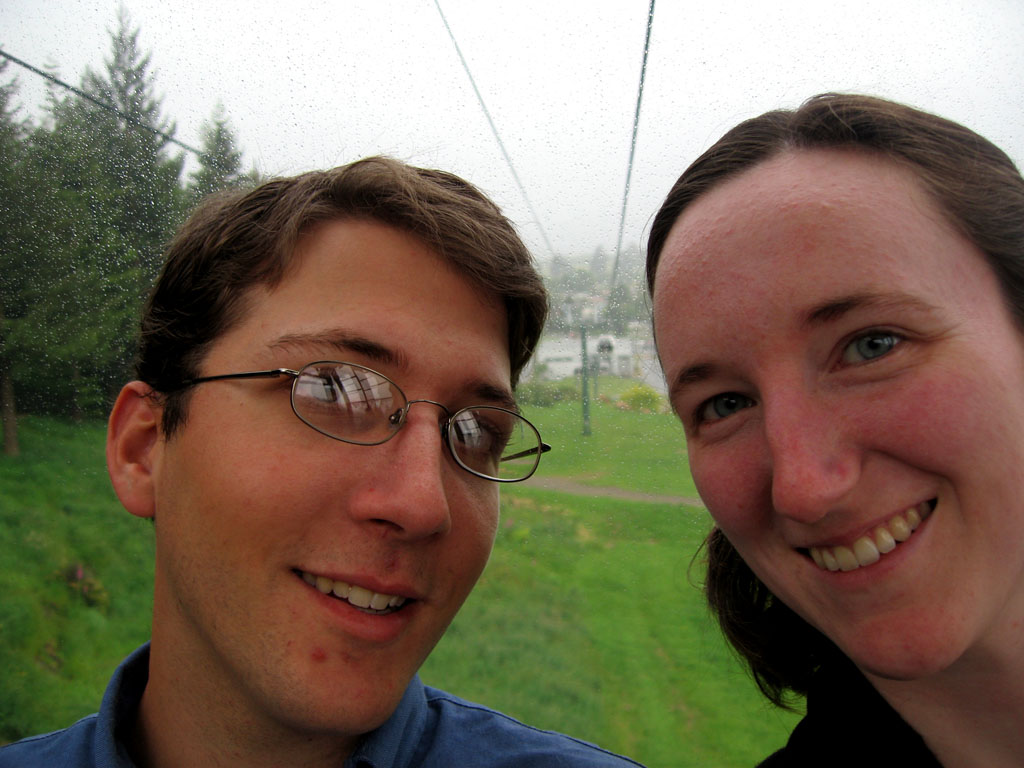
We took Friday night off to attend the forest company's Christmas party. It was pretty awesome that we got invited because we're just volunteers. It was at a venue in Rotorua, which is a major tourism town for the North Island because of its thermal pools, geysers, and Maori culture. We took a gondola up a hill overlooking the town of Rotorua and Lake Rotorua. Unfortunately, it was raining so we didn't have a very good view.


Once we got to the top, we had to LUGE halfway back down to the dinner location! This was such a blast. You sit in a little cart and roll down the hill on a paved track. We only had time to do it twice and it was raining both times so we didn't get any pictures of us on the luge :-(

The rest of the Christmas party consisted of dinner, drinks, and dancing. It was awesome to watch all the people out on the dance floor. Actually, it really made me miss Earlham! We only knew about 4 of the 200 people at this place so it wasn't quite the same as a rockin party on College Ave where you know everyone except the first years who just showed up. The uninvited guest at this party was a possum who wandered his way into the food tent around 9:30 when dinner was finished and the dance floor was heating up. We got the impression he'd done this before.


Possums were introduced to New Zealand from Australia and have become a major pest. There are approximately 4 million New Zealanders, 40 million sheep, and 70 million possums. The possums love to eat the native flora and fauna. They are trapped and poisoned, but they persist. I think this might be one of the only places in the world where swerving to HIT a mammal crossing the road is socially acceptable. Remember, their only native land mammals are bats, so all the rabbits, hares, possums, weasels, and deer are introduced (supposedly there are even some moose on the South Island. Imagine that- introducing and losing your MOOSE in the bush). I am amazed at how many possums we see driving along the forestry roads at night. We can hear them, too, while we're sitting around waiting to catch bats. They can make very unsettling sounds when you're sitting alone at night in the bush. I was totally surprised to see 'merino wool and possum fur' products all over the place when we arrived in Christchurch. The possum has beautiful, warm fur that they blend with merino wool to make gloves, socks, sweaters, scarves, and the like. Or they just skin the possums and make fur products like slippers and hats. New Zealanders would really like their 'fur for conservation' to catch on internationally. Ironically, the possum is threatened in its native Australia.

Tonight we'll try again for bats. Cross your fingers!

Carrie

P.S. We're really enjoying seeing where our blog visitors come from. We think we've got most of the locations figured out. Since we put up the little city counter on Friday it looks like there are lots of people from the forestry company (who show up as Auckland), my parents, Sarah K., Megan K.?, Cathi, Coco, Rusty & Wal?, and Adam.

Sunday, November 19, 2006

A book about bats

Silently By Night: About the little-known but fascinating world of bats
by Russell Peterson


There are only two books about bats at the Tokoroa Library, and this is one of them. I was surprised I hadn’t heard of it before, since I have a fairly long list of bat books on my Amazon.com wishlist but this wasn’t on it. This book was published in 1964 and really dates itself with statements that try to explain the distribution of different bat families around the world, “There have been varied hypotheses regarding the representation of species in both the Old and New Worlds, ranging from the wildly improbable to some very sound reasoning. Wegener asserted that there was a splitting of world, one drifting from another. Matthew reasoned that land masses have remained stable except for the flucuations of tide levels and eruptive forces from within the earth.” Boy, was Peterson wrong in his reference to the ‘wildly improbable’ and the ‘very sound reasoning.’ This book made it to print just a year before continental drift was accepted, and Peterson’s statements made in pre-drift ignorance have demonstrated to me how profoundly plate tectonics enhanced our understanding of biology. For example, now that we know when Pangea split up to form Laurasia and Gondwanaland, we are better able to understand why Australia and South America have marsupial mammals and the rest of the world doesn’t (with the exception of the Virginia opossum in North America). This site has a good explanation if you’re interested:
http://biology.clc.uc.edu/courses/bio303/contdrift.htm

The second obvious way in which this book dates itself is Peterson’s zeal for collecting bat specimens. He wrote, “… for what naturalist will not glory in a fresh specimen of an exceptionally rare species of animal?” While we can still learn much from the zealous collecting of earlier generations of scientists, we mostly opt for methods of study that don’t destroy the subject.

Like Krakatoa, the writing style was pretty old fashioned (unlike Krakatoa, this one really was 40 years old!). I don’t think I’d recommend it to anyone unless they were already really interested in bats, since now there are much better books out there to introduce people to this unique critters. My favorite aspect of the book were the little illustrations of bats in the page margins.


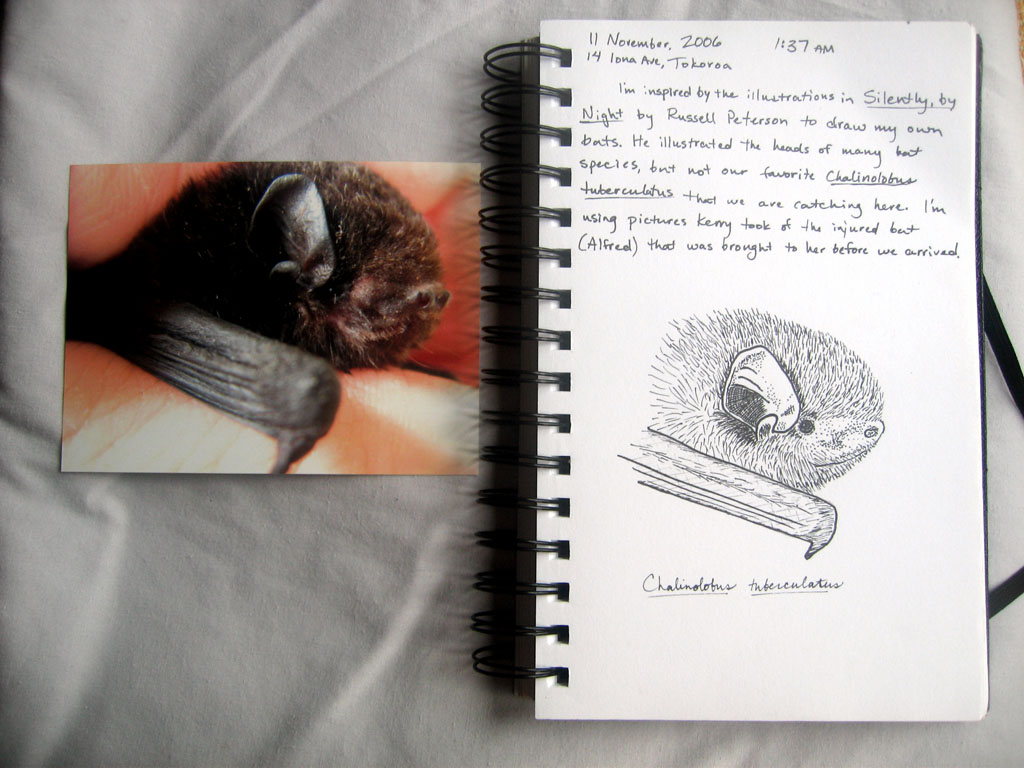
He didn’t have a drawing of the long-tailed bat, so I was inspired to do a drawing of my own.


This is drawn from a photo Kerry took of Alfred (an injured bat who was brought to her before we arrived). Alfred, Bernie… we’re going in alphabetical order so the next bat we catch will start with C.

Carrie

P.S. Our next post will be about what we've been up to instead of just what we've been reading. We just got back from 4 days along the nice, warm coast.

Monday, November 13, 2006

The Bernie Update

We successfully radio tracked Bernie for nearly two weeks. Last night the weather was cold, wet, and windy, so Matt and I just sat in the car by Bernie's day roost the whole time because he didn't leave. The tiny radio transmitter batteries die after about two weeks, so we knew we wouldn't be able to track him much longer.

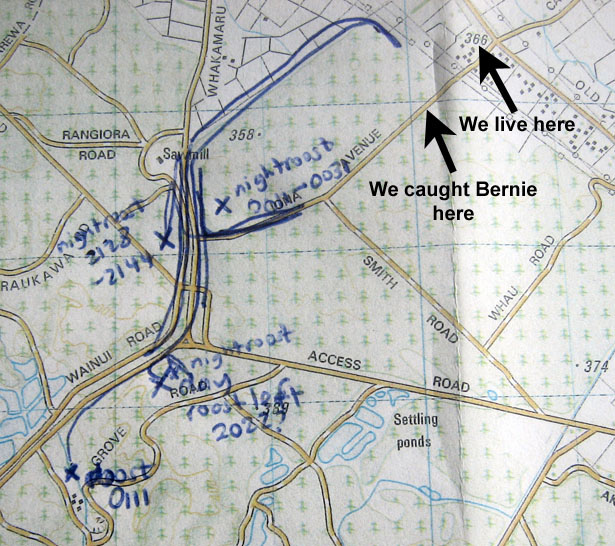
From what we've seen, Bernie has a pretty regular foraging routine. The picture of the map below shows a typical Bernie night. His day roost is marked with an X along with other night roosts. The pen lines in between are approximately the paths he's flying.


We start each night with one car waiting near his day roost and one car waiting up the road. When the person at his night roost hears him moving, they radio the other car to tell them he's on his way. Then he usually flies back and forth along the road for most of the night with some breaks and side trips.

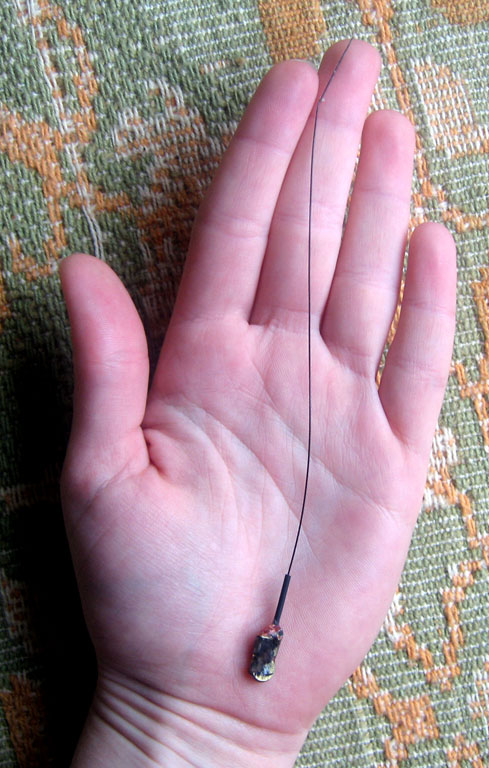
This afternoon when Kerry went to check on Bernie at his day roost, she made an exciting find- Bernie's transmitter! He must have lost it late last night after we stopped tracking him. The battery was still working so Kerry was able to find it. It's quite a big deal to recover one of these because they cost at least $200 each. It will need a new battery, but it's still perfectly useable!


Imagine trying to find this on the forest floor. You can kind of see where some of Bernie's hair is still stuck to it.

Now that we're finished tracking Bernie, Matt and I get some time off until November 20 because Kerry won't need our help until we start trying to catch bats again. Tomorrow we're going to visit Kerry's family on their dairy farm, and then we're going to spend some time on the coast. Hopefully, it will be sunnier, warmer and drier than here!

Carrie

Thursday, November 02, 2006

In hot pursuit of Bernie

Wednesday night was quite a night. Kerry did some amazing radiotracking on Wednesday afternoon and found the area where Bernie was roosting. It was in a stand of eucalyptus trees. Eucalyptus was introduced from Australia and is grown in this forest in addition to lots of pine. Kerry was able to narrow it down to a couple of trees, but couldn't figure out exactly which one.


This is a picture looking up at the Eucalyptus trees where we suspect Bernie is roosting.

Kerry and I went out to the roost site before sunset with our radio telemetry, bat detector, and night vision in the hope that we could watch Bernie (and other bats) emerge. Matt was stationed on a nearby road in position to follow him when he took off. Well, he took off with little warning and only one call before he disappeared completely from our telemetry at 8:33 pm. Kerry and I had to tear down the hill back to the car through heaps of blackberry brambles. Meanwhile, Matt followed Bernie up the road towards where we first caught him. It turns out he has a relatively repetitive foraging route, so we spent a long time driving up and down the same roads. He even forages within telemetry range of our house! He stopped at two different night roosts in some pine trees for a while. Bats often take breaks during the night while they're out foraging. Amazingly, we were able to track him pretty much continuously from when he left the roost until he returned to it shortly after 1 am. Then we sat and waited for four more hours, until 5:30 am, to see if he'd leave to forage again. We weren't expecting him to return to the roost so early. We'll see if this trend continues.

Last night was definitely our latest bat night so far. But what an accomplishment! We tracked him for 9 hours

Carrie

P.S. Marie Adele- bats are not slimy. In fact, they are actually quite warm and fuzzy. Snakes aren't slimy eiither, by the way, so don't listen if anyone tries to tell you otherwise.

Wednesday, November 01, 2006

Bernie the Bat

We’ve been in Tokoroa for two weeks now. I really should’ve explained what we’re doing here a while ago, but I was trying to wait until we actually caught a bat. By Monday night I’d resigned myself to posting to the blog even though we hadn’t caught a bat yet when WHAM-- we got one. Ever since then, we’ve been quite busy trying to keep up with it (I’ll explain later).

So what exactly are we doing here? I am planning to begin graduate school in August 2007 for a Ph.D. in ecology. I’m especially interested in bat ecology, so when Matt and I decided we were coming to New Zealand, I contacted some bat researchers here. They put me in touch with Kerry Borkin, a grad student beginning her Ph.D. research who was looking for volunteers. I got in touch with her back in May and arranged for us to work with her for a few months. So now we’re in Tokoroa living in a house with Kerry and assisting with her research.

New Zealand has two species of bat: the long-tailed bat and the short-tailed bat. These are New Zealand’s only NATIVE land mammals. In spite of what their common names would lead you to believe, the long and short-tailed bats are not closely related at all. The short-tailed bat, with few native predators, is actually quite quadrapedal and forages on the ground in addition to flying. Kerry is studying how the long-tailed bats use the huge exotic pine plantation surrounding Tokoroa. This involves identifying where they are roosting and foraging within the forest.

For the past few months, Kerry has been using Automatic Bat Monitoring units (ABMs) to record bat activity in different parts of the forest. The ABMs record the bats’ echolocation calls that are made audible to us by a bat detector. You can also just use a bat detector (separate from an ABM) to listen for bats. Last Wednesday, Kerry’s advisor from the University of Auckland came down to train the three of us how to catch bats. Kerry is just beginning her research so she was learning with us. On Wednesday and Thursday nights we set up mist nets near a pond where an ABM had recorded a lot of bat activity. We listened for them with bat detectors and used night vision goggles to watch for them, but it was much more fun to use them to look at the stars. The bats seem to be active in those areas until about midnight, so we closed up the nets and headed home around then. No bats in the net on Wednesday.

This picture is pretty blurry because it was taken by holding the camera up to the night vision eyepiece, but I think you get the idea.

On Thursday night, Kerry invited a man who works for the forest company to come look for bats with us using his thermal vision camera. That’s right, we’re talking night vision and thermal vision like right out of the first person shooter video games. When you focus the camera on something, it will tell you the temperature of the object. This camera is INCREDIBLY cool. So incredibly cool that it made night vision seem quite boring.

This is a picture of me in thermal vision. Again, it’s blurry because we just held the camera up to the eyepiece. The camera operator might send us some of the better images he captured, in which case we’ll try to post them. You can see from the scale on the right that my nose is the coldest part of my face.

These cameras cost over $100,000, but the forest company uses it at their paper mill to detect leaks and equipment that isn’t running properly. Apparently it saves them a pretty penny to be able to pinpoint problems precisely with this precious piece of picture producing paraphernalia. We could see the bats swooping down to the water with our thermovision. Unfortunately, we didn’t catch any in our nets.

On Friday night we put up the mist nets just down the road from our house. Only one bat was detected with the bat detector and it didn’t visit our mist net. Around this time, we learned that someone else did her Masters thesis on bats in this forest and never caught a single bat. Yikes. That would be a real bummer. Saturday night we tried catching down the road again and didn’t even hear a single bat on the detector. Sunday night was crappy weather so we had the night off.

Monday night we set up on the road again. We put up a 9 m high mist net (I like to call it the Big Rig) across the road and a smaller mist net nearby across a trail. The three of us were taking turns watching the two nets and waiting in the car when it happened- a bat flew into the mist net! We untangled the bat, bagged it, took down our nets, and brought everything back to the house. When you catch a bat the night is just beginning. We took measurements, collected hair and poop, and named him Bernie. Most importantly, we glued a wee radio transmitter onto its back. This allows us to track it, and makes sure that none of the cool bats will play with it at recess.


Not a bad shot of him, but unfortunately you can’t see his little eyes. I promise he has some.


Tiny little thing, isn’t he?

At this point, things get complicated. We had two vehicles and two radio antennae. All kinds of things can go wrong at this point. Once you release the bat, the radio transmitter could fall off and that’s the end of tracking that bat. Or the bat could fly a completely different way than you expect it to and you could lose the signal in a matter of minutes. Thankfully, we got lucky. Matt drove and radiotracked in one car while Kerry drove and I radiotracked in another car. We were able to track the bat for an hour! Not bat at all for our first bat tracking.

There are two things to be determined from radio tracking. The first is a bat’s foraging path. More importantly, it can be used to find roosts. So on Tuesday (in daylight), we drove around the forest trying to pick up a signal to no avail. No leads yet on where this bat is roosting. Theoretically, we have about 2 weeks to find it before the battery on the transmitter dies.

Carrie

Wednesday, October 18, 2006

We've Arrived In Tokaroa

Disclaimer! Disclaimer! Disclaimer!
This is going to be a long post.

So, we had an amazing drive up from the South to the North and I intend to tell you all about it here. Cheers to those of you who make it to the end. I recommend clicking on the pictures to make them larger. They are better bigger.

Day 1 - Tuesday, October 10th
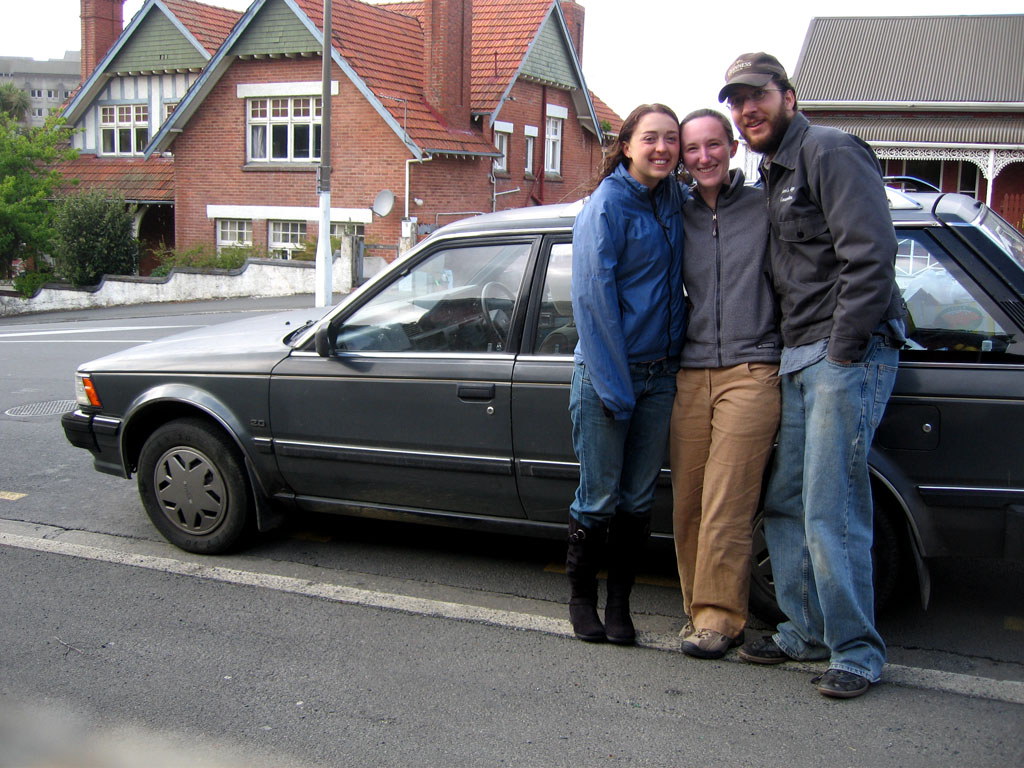
First off, we bought a car. Her name is Lu and we bought her from Elizabeth who will be leaving for the States in a few month and wanted her car to "continue the adventure." She's an '83 Nissan Bluebird wagon. Her name comes from her model (bLUebird) and her license plate number is "LU 234."


We had a bit of a late night on Monday night hanging out with Elizabeth and some other friends we met at the hostel so our start was much later than we had planned. We got out of Dunedin around 11:00 am. From there we drove south to the city of Invercargill [1]. If you've seen the movie "The World's Fastest Indian" Invercargill is where the main character is from.


Invercargill also has a Tuataratarium (that's what I call it). Tuatara are these amazingly weird reptiles that only live in NZ and are very very rare. I strongly recommend you read the wikipedia article on them here: "http://en.wikipedia.org/wiki/Tuatara". These things are amazing. The picture is of one named Henry who is AT LEAST 125 years old. They don't actually know when he was born but he's very old.
Invercargill is basically the bottom of the island so from there we dove north. We did several things along the road including running into the freezing ocean (I didn't think it was going to be so deep!), checking out a hundred year old suspension bridge, and doing a bit of caving where we saw our first glow worms. We bought the station wagon so that we could fold down the seats in the back and camp right there in the car so that night we parked along the shore of Lake Manapouri [2], constructed some curtains that go up with velcro, and slept the night.

Day 2 - Wednesday, October 11th
The back seats folded down were very uncomfortable and it turns out we parked on the side of a logging truck road so we woke up at about 6:30 am. We continued north and came to a town called Te Anau where they have a "Wildlife center." We knew we wanted to stop here because they have several of the very rare Takahes. These flightless birds were thought extinct until they were rediscovered in 1948. Again, I strongly recommend the wikipedia article here: "http://en.wikipedia.org/wiki/Takahe".


The Takahe in the picture is named Bruce and they don't know how old he is. The sign just said "very old." As soon as we walked up to his enclosure he trotted right over and said hello. He watched us for a bit and then he started making these guttural noises and then he turned around and spread out his wings to display for us. Carrie thinks he fancied her but I think he was after me. At this center there were lots of examples of NZ wildlife (which means birds).
From Te Anau we decided to take some extra time and drive all the way up to Milford Sound. This is a good time to interject some comments about NZ roads. In NZ they don't really have large highways and they certainly don't have anything similar to US Interstates. Instead, all of the major roads are one lane each way and very windy (as in meandering). There also aren't many of them. Basically there is one highway on the East coast of the island and one on the West coast of the island and a few that connect them. On these roads (especially on the West coast where it is very mountainous) there are many bridges. On the South island these bridges are mostly one lane. That means that there are a lot of yield signs. If any of these bridges were washed away or damaged in anyway it would mean that you could simply no longer get to the West coast. It great! All of the routes in NZ are the scenic route. Ok, back to our trip.
Milford Sound [3] in a long way out of the way. To get there you have to drive about three hours North up a very windy road and then (because this is NZ) to leave you have to come all the way back South again before you can continue your Northerly direction. We had been told by people before we left that we should not miss Milford Sound so we went for it. It is, we have learned, one of the biggest tourist destinations in NZ. It is sort of akin to the Grand Canyon in the States. Everyone goes there. We had already resigned ourselves to doing some things that were very touristy and in some cases things are so popular with good reason. Milford Sound was incredible! First of all the drive there was unbelievable. Gorgeous mountains and beautiful waterfalls. On our way we stopped a lot to see all of the amazing places on the way. We took a hike out to Humbolt Falls (pictured below). If you look closely at the photo you can see that the falls are actually three tiers. I wish we could have gotten closer.
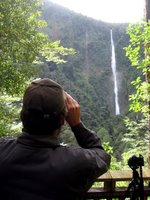

After the falls we visited the "Mirror Lakes" which were beautiful, Lake Gunn with was immaculate, and a Chasm which I can't even begin to describe, sorry.


The views as we drove along were amazing. For a large section of the drive you are not allowed to stop the car because on avalanche danger but there was one spot designated as a "safe stopping spot" and we stopped there to take some pictures. Waiting there for us were these two Keas. The Kea is another NZ native bird. It is like a large green parrot with a very hooked beak. They are known to be troublemakers. They have no fear of people and they are very intelligent which makes them very curious. Apparently these two keas have figured out that this one spot is the only place where people stop so they just hang out there all day waiting for the next tourist. We had not stopped for more than a minute and they were already on top of Lu chewing on windshield wipers and the roof rack. Apparently they are known for letting air out of tires because they like to play with the air valves. It was pretty funny.


In order to get to Milford you have to go through a tunnel through the mountain for about a kilometer. It is the sketchiest tunnel I've ever seen. The walls are rough cut and the whole tunnel is lit with what seem to be 10 Watt bulbs. They did paint the rock walls white so that you can kind of see them but it was pretty scary going through.


Once we arrived at Milford Sound we realized that to really see it we were going to have to take some sort of boat out onto the water. Milford Sound is actually not a sound we learned. It is a fjord. The town of Milford is very small and sits at the inland-most end of the fjord. We took a tour boat cruise to go see the rest of it. Basically you have to imagine cliffs standing some 1200 meters high rising directly from the water. The cliffs actually continue straight down under water and the fjord is 300 meters deep. 300 meters! The water is perfectly black because it is so deep. Along these sheer cliffs are hundreds of waterfall. Every year at Milford they get about 6 meters of rain so everyone we had talked to warned us that it would rain while we were there. Actually it was misty and a bit wet but it was comfortable. When it rains there are even more waterfalls. There are only about 6 or 7 that are permanent but it was wet enough for us to se many falls. The highest falls in the sound (everyone calls it a sound so I'm just going to do that too) is Bowen falls which stands 520 feet high. For comparison Niagara Falls are only 170 feet high. The boat took us the length of Milford all the way to the Tasman Sea and back. Along the way we spotted a Fjordland crested penguin in the water. That was exciting.
After our trip we took off back South and retraced our steps to Te Anau where we could turn inland and head North again. Queenstown [4] is a very touristy town on our way where there is a very young crowd of bungy jumpers and skydivers and such. It is very easy to spend a lot of money in Queenstown so we decided to just drive on through. We spent the night at the side of Moke lake [5] in a campground this time. We learned that we can stay at Department of Conservation campgrounds and not be disturbed by logging trucks. Rusty and Wal suggested Moke lake and we can't thank them enough. It was beautiful.

Day 3 - Thursday, October 12th
We slept a bit better that night because there were no trucks but we still got up at 8:00 am because the back of Lu just isn't that comfortable (yet). We went and did a geocache at a place called Bob's Cove. It was very nice we were actually the first to find the cache which is exciting in the geocaching world. We drove back through Queenstown and we visited a cool old Chinese gold miners settlement in a small town called Arrowtown. From there we went further North until we stopped at a place called "Puzzling World." I don't remember how we heard about if but it is this really cool place where they have all of these examples of optical illusions and puzzles and they have a huge maze that you can go through. The paths in the maze are about 1.5 kilometers in total and it was a real challenge. We used a theory I had been dying to try out since middleschool for just such a situation. If you just keep your hand on one wall the whole time you can guarantee not to repeat anything and you will find your way out. It worked great.
After the geocache we were headed out of town when we passed the local "Resource Recovery Center". Now, we don't really have these in the US but we should! Rusty and Wal taught us the benefits of the RRC. Basically what it is is a store at the dump. They collect all of the things that people throw away that are still good and sell them very cheap to people who need them. Its like a thrift store that is stocked by dumpster divers. They have these stores all over NZ. So we swung by the RRC and bought a perfect foam mattress. it doesn't smell and it was clean and beautiful we got it for $5 and threw it in the back of Lu. We've never slept so well. Best $5 ever spent.
The whole trip we have been doing geocaches because they are free and they bring us to cool places. I'm not mentioning all of them because there were a ton but this next one really deserves a picture so I'm putting it up. This place was called the Blue Pools and you wouldn't believe how blue this water was unless I posted a picture. It was amazing! And the water was perfectly clear so you could see all of the huge trout just swimming away in there. Beautiful!
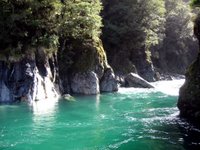

That night our camera battery died so we stopped at a local pub and plugged it in while drinking a beer. Speights! its great stuff, if you can get it anywhere in the States let me know because I'll be very excited. After our battery was mostly full we went to our next campsite at Lake Paringa. It was another DOC campsite and, with our new mattress, we decided we could sleep in a bit. It was great!

Day 4 - Friday, October 13th
Friday the 13th! We slept great and the day started off very well with a visit to Fox glacier. The sun was shining (which we had heard was very rare on the West coast) and the glacier was incredible. I'd never seen a glacier. I never really knew what to expect. I guess I figured it would just be a bunch of white snow or something. I just didn't know. It turns out that glaciers are really beautiful. Not to mention huge! In the picture below you can see me standing in the bottom right corner and where I'm standing I'm still about 100 meters from the base of the ice. It was really really big.


After that we went for a hike around this lake where, on a clear day, you can see a perfect view of Mt. Cook (the largest mountain in NZ) reflected in the water. Odds are good that if you've ever seen a picture of Mt. Cook it was taken there. It was not a clear day so we just hiked around the lake, grabbed a geocache, and set off. From there we went to visit the other glacier nearby (Fraz Joseph Glacier) but by this time the fabled West coast rain had set in and the weather made us grumpy.
We continued North trying a few geocaches and basically moped because of the weather. There was one cool geocache on an abandoned railway bridge where we had to walk out onto the bridge to retrieve it. It was a bit dodgy but easy enough that it was fun. That evening we visited a glow worm dell in Hokitika. Glow worms are really cool. There is the spot where you can walk in and all of the walls of this forested dell are covered in glow worms. I think fireflies are cooler but we'd never seen glow worms like this and it was beautiful. That night we stayed at another DOC campsite nearby.

Day 5 - Saturday, October 14th
It was rainy and nasty still when we woke up. We continued North until we got to Greymouth which is a pretty big city. The day before we had a realization that libraries are good places to stop to charge the computer, the iPod and the camera so we stopped at the Greymouth library. While we were in there Carrie noticed a sign on the street that said that a restaurant nearby had free wireless. We decided that it would help our mood if we had some good food and checked our email etc. It was a Persian restaurant and I had some Spana Kopita which was pretty good but not as good (or plentiful) as Mom's.
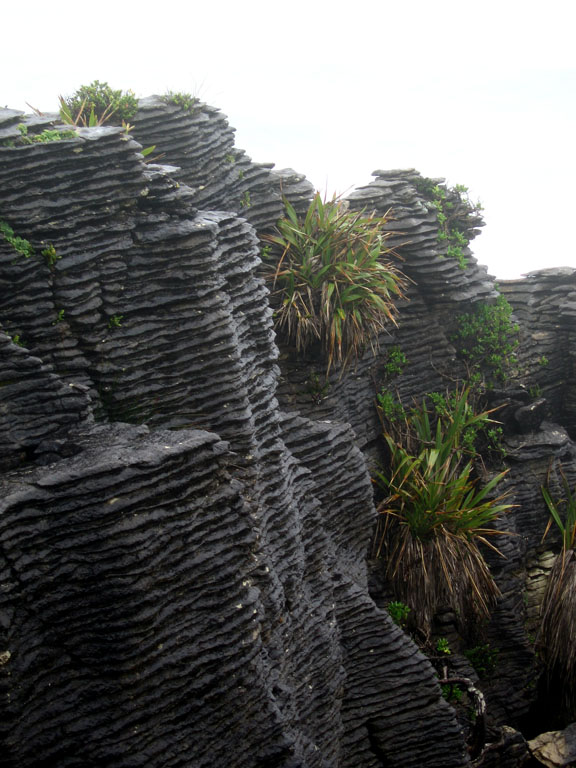
After our relaxed time in Greymouth we drove to these very cool rock formations at Punakaiki. The rocks were formed in such a way that the wear of the ocean of thousands of years has made them look like very tall very crunchy stacks of pancakes. They were dramatic and cool looking and I'm sure that if the weather had been better we would have found them even more so.


After several more geocaches and a bunch of driving we finally departed the West coast and were ecstatic to see the Sun again. We spent the night at another DOC campground where there was a cool geocache at the end of an old railway tunnel.

Day 6 - Sunday, October 15th
When we woke up we couldn't believe that the dreary weather had followed us over the mountains. It was rainy and gross again. So we got back in the car and continued to drive North until we got to Nelson which was a beautiful city with great weather. In Nelson we went to an art gallery which sucked. I don't know about you all but I'm really sick of art where the message is "look art can be anything." I feel like that point was made a long time ago when Marcel Duchamp hung a urinal on a wall and called it art. This whole gallery was filled with stuff that was still saying the same thing. I guess I'm old fashioned but I like art that takes talent. There were two exceptions. One was a woman who had made these small Chinese style pieces depicting several mythical creatures and scenes. They looked like they were beautifully done pen on paper but when you read the description it said that they were actually needlepoint done with the artist's hair. It was really amazing. There was such detail that you really could not tell they were sewn. The other exception was a woman who did these combination pieces of painting and metal work. They were mostly square paintings connected by metal pieces. It is hard to describe but they were really beautiful. Carrie and I agreed that if we had money we would have purchased one.
From there we went East to Picton which is where the ferry across the Cook Straight departs. Our ferry was at 8:15 am on Monday so we had plenty of time Sunday afternoon to just mill about Picton. We ended up taking a twenty cent ride on a model train to support the local model engineer's club and went to our camp site at a about 3:00 pm. I read for the afternoon and Carrie spent some time drawing (more on that in another post).

Day 7 - Monday, October 16th


We had to get up quite early in order to drive form our campground to the ferry and all three of us (Carrie, Me, and Lu) were unhappy about it. But we pulled through and arrived at the ferry about an hour early. We were the second car on the boat. The ferry was a very large boat. Probably the largest boat I have ever been on. It was fun. The trip takes about 3 hours and the ferry is very comfortable. It is like a cruise ship. The weather could not have been better for our crossing. Beautiful blue skies, not too windy and calm seas. We spent the whole trip out on the deck watching for whales. No luck though. We did see quite a few albatross though and one fur seal. That was exciting.
The ferry dropped us off in Wellington (now we're on the North Island). We had decided that a hot meal would be nice so we went in search of good food. Before long we ended up at an Indian restaurant (mmmm). After lunch we had an amazing set of coincidences that turned disaster into triumph. When we returned to our car we had a ticket in the wiper for $200! We couldn't believe it! The ticket said that we did not have current registration displayed. As we were trying to figure out what we had done wrong (it turns out we had our registration covered by another piece of official paperwork and didn't know we had done anything wrong) a man who just happened to have parked right in from of us right then just happened to ask us what was wrong. He told us that we should just go into the office of traffic violations (where he just happened to be going and directly in front of which we just happened to have parked) and tell them the situation. So we did, we proved that we did in fact have registration and the lady said we were all set. No trouble. It was a bit of an emotional rollercoaster.
From Wellington to Tokaroa (where we are now) is about 500 or 600 kilometers so we spent the rest of the day just driving North to get here on Monday night. We had great weather the whole way up except that it rained in the desert while we drove through (go figure).

Anyway, that was our trip. I'm going to let Carrie post sometime later about what we are doing here in Tokaroa but we could not have had a better trip really and we are excited to get started working with bats.

Congratulations, you've made it to the end.

Matt

p.s. We've signed up for dial-up here where we are so we will be in email contact pretty much.

[1] Invercargill 46°24'18.98"S, 168°21'14.69"E
[2] First Camp 45°25'19.31"S, 167°42'47.26"E
[3] Milford Sound 44°39'7.20"S, 167°55'35.99"E
[4] Queenstown 45° 2'21.97"S, 168°42'29.23"E
[5] Moke Lake 45° 0'1.97"S, 168°34'9.67"E

Archive