Showing posts with label books. Show all posts

Friday, February 02, 2007

Our Mission and Addiction

While we were doing the bat thing in Tokoroa, Matt checked out a book from the library called Wrecked on a Reef. It was a true account of a shipwrecked crew on New Zealand’s tiny subantarctic Auckland Islands (S 50°48'30.04", E 166° 5'25.11") in 1865. The book was originally printed in 1866 and was reprinted in 2000. Matt decided right away that this book would be a perfect gift for someone he knows (sorry, we can’t tell you who in case you’re reading the blog). Ever since then we’ve been trying to find a copy of this book that we can afford. We’ve asked in every used bookstore we’ve visited in the past two months. It’s online, but unfortunately the only copies there are out of our price range. So, we’re on a mission to search every used bookstore, op-shop, Sallies (Salvation Army), antique store, and junk shop we pass.

Now Matt and I both like to read, and we like to have books. As a result of searching row after row of books, we find others we’d like to read. I find nerdy natural history books (most of which are too expensive) and Matt finds lots of fiction. Our small library of books no longer fits in its designated box. I think Matt has enough books to last him until the end of our trip. I was really hoping that Matt would part with some of his books after reading them, but he seems only to be acquiring books that he intends to bring back to the U.S. and keep forever. Books are our addiction.

By the way, we’re back online after a week tramping and canoeing in the bush. In the past week we've slid down waterfalls, canoed a river, hiked across volcanoes, and eaten lots of granola bars. Expect more tales and pictures of our adventures to follow shortly!

Carrie

Sunday, November 19, 2006

A book about bats

Silently By Night: About the little-known but fascinating world of bats
by Russell Peterson


There are only two books about bats at the Tokoroa Library, and this is one of them. I was surprised I hadn’t heard of it before, since I have a fairly long list of bat books on my Amazon.com wishlist but this wasn’t on it. This book was published in 1964 and really dates itself with statements that try to explain the distribution of different bat families around the world, “There have been varied hypotheses regarding the representation of species in both the Old and New Worlds, ranging from the wildly improbable to some very sound reasoning. Wegener asserted that there was a splitting of world, one drifting from another. Matthew reasoned that land masses have remained stable except for the flucuations of tide levels and eruptive forces from within the earth.” Boy, was Peterson wrong in his reference to the ‘wildly improbable’ and the ‘very sound reasoning.’ This book made it to print just a year before continental drift was accepted, and Peterson’s statements made in pre-drift ignorance have demonstrated to me how profoundly plate tectonics enhanced our understanding of biology. For example, now that we know when Pangea split up to form Laurasia and Gondwanaland, we are better able to understand why Australia and South America have marsupial mammals and the rest of the world doesn’t (with the exception of the Virginia opossum in North America). This site has a good explanation if you’re interested:
http://biology.clc.uc.edu/courses/bio303/contdrift.htm

The second obvious way in which this book dates itself is Peterson’s zeal for collecting bat specimens. He wrote, “… for what naturalist will not glory in a fresh specimen of an exceptionally rare species of animal?” While we can still learn much from the zealous collecting of earlier generations of scientists, we mostly opt for methods of study that don’t destroy the subject.

Like Krakatoa, the writing style was pretty old fashioned (unlike Krakatoa, this one really was 40 years old!). I don’t think I’d recommend it to anyone unless they were already really interested in bats, since now there are much better books out there to introduce people to this unique critters. My favorite aspect of the book were the little illustrations of bats in the page margins.


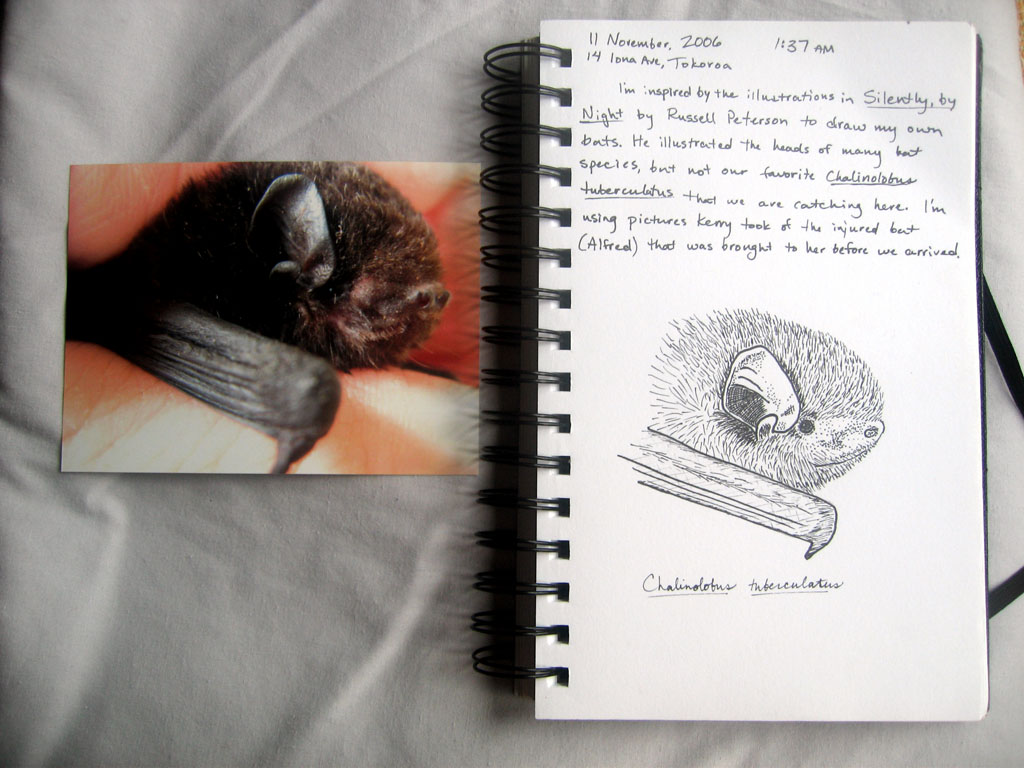
He didn’t have a drawing of the long-tailed bat, so I was inspired to do a drawing of my own.


This is drawn from a photo Kerry took of Alfred (an injured bat who was brought to her before we arrived). Alfred, Bernie… we’re going in alphabetical order so the next bat we catch will start with C.

Carrie

P.S. Our next post will be about what we've been up to instead of just what we've been reading. We just got back from 4 days along the nice, warm coast.

Nothing to do with New Zealand: a more interesting book review

Lions of Tsavo: Exploring the Legacy of Africa’s Notorious Man-Eaters by Bruce Patterson


This is a very long post that has nothing to do with New Zealand, but it does have a lot to do with my time in Kenya. This book has intersected remarkably with my own life in many unanticipated ways. I’ll explain that later, though.

Bruce Patterson is a mammologist at the Field Museum of Natural History in Chicago. This book covers a range of interesting physiological and ecological questions brought up by two famous lions killed in 1898. During the construction of the Kenyan railroad from the Indian Ocean to Lake Victoria, about 135 workers were killed by two male lions before they were shot. Their skins are now on display at the Field Museum. The movie Ghost in the Darkness is based on this story (I haven’t seen the movie so I can’t say how closely).

The first part of the book examines the story of the Tsavo man-eaters as well as other man-eating lions to identify potential causes of human hunting. It seems to be a combination of factors, including reduced availability of normal prey items, scavenging human bodies after epidemics, and injury to lions that prevent them from hunting the harder-to-kill prey (humans are quite easy). These chapters are incredibly gripping (and often gruesome).

Besides eating people, the Lions of Tsavo are remarkable because they are nearly maneless even though they are adult males. Maneless lions are still found in the Tsavo region (and elsewhere) today. The second part of the book examines potential explanations for the causes of manelessness in lions. In 2002, Patterson started studying lions in the Tsavo area by radio collaring a male, ‘Romeo,’ and following the behavior of prides and individuals. In short, it seems that Tsavo is so hot and dry that the physiological disadvantage of having a mane is greater than the sexual advantage of having one.

Patterson also addresses the complex relationships between humans and lions. We kill them to prevent them from killing us, sometimes we let people pay a lot of money to kill them, and we’re still trying to protect them without compromising the safety of people that have live with them. I find these kinds of dilemmas fascinating and resolving them is incredibly important for conservation all over the world.

Overall this book is captivating and easy to read. I especially like the way Patterson presents the testing of various hypotheses about lion ecology. The book seems to be well-edited, although I did find two footnote errors (one was on the wrong page and one was duplicated). Much of the research Patterson describes was still in progress when the book was published, so I am left wanting more. I wish he had waited a few more years to write the book. Perhaps there will be a sequel.

I recommend this book for anyone interested in big cats and especially lions. I also recommend it as post-safari reading if you’re going to Africa. Since about one-third of the book is story after story of man-eating lions, I think it is best read in the comfort and safety of a building on a different continent (like New Zealand) instead of in a tent in African bush.

How this book has crossed my path numerous times:
First of all, in the summer of 2002 I worked at the Field Museum sorting tiny shells from microscopic ocean bottom sediment. The Man-Eaters of Tsavo have a prominent display on the main floor of the museum and I walked past them frequently. Shortly after ending my internship at the Field, I flew to Kenya to begin my semester-long program there with Earlham. Our group of 17 Earlhamites met at the Amsterdam airport and flew to Nairobi together. While I was in the Amsterdam airport, Bruce Patterson (the author) struck up conversation with me because we had been on the same flight from Chicago to Amsterdam and were continuing on the same flight to Nairobi. He was going to Kenya to lead a Field Museum expedition. We had a brief conversation about the Field Museum and such since I’d just worked there (though our paths never crossed in the Museum as far as I’m aware).

The Kenya program traveled to many places around the country, including the Taita Discovery Center located on the Taita-Rukinga Ranch situated between Tsavo East and Tsavo West National Parks. Taita Ranch was the location of Patterson’s lion radio collaring work to study the maneless lions of Tsavo. Teams of Earthwatch (www.earthwatch.org) volunteers had been out earlier in 2002 collecting data on ‘Romeo,’ the radio collared male. Well, one night while our group was at the Taita Discovery Center, we had the opportunity to go out in search of Romeo. They said there was no guarantee we’d find him- we might just drive around in the dark for hours with no lion sightings. About half of our group (regrettably including me) decided to stay at camp while the other half of the group quickly found Romeo and got to watch him mating with lionesses. The group who went came back around midnight positively wired with excitement. I decided to go to bed early and thus missed my chance to see the Romeo featured in Patterson’s book.

While I was in Kenya, I knew about the man-eaters of Tsavo. I knew that sometimes people were killed by wildlife (although elephants, hippos, and buffalo are the most dangerous). But I didn’t know that man-eating lions actually make a habit of it. I didn’t know that lions in search of the sweet taste of human flesh have gone into houses and tents and chosen one unlucky person from the lot to eat. Ignorance is bliss, and I was thankfully blissfully ignorant of these facts because I had an experience that was absolutely terrifying without this additional knowledge. A few of you have heard this story, but I think most of you haven’t and I think it is worth repeating because it is one of the most unforgettable experiences of my life.

In the middle of the Kenya program, we spent three weeks at a field station at Lake Naivasha, Kenya. During this time, we were doing small group projects for our ecology class. Many of us chose to work in the nearby Hell’s Gate National Park (I spent 30 hours observing zebras- you really can tell them apart by their stripes). Hell’s Gate is to small to support many carnivores or large herbivores such as elephants and rhinos, so it is one of the only game parks in Africa where you can walk around on foot. Shortly before our group arrived, a pride of lions was seen in the park, which was quite unusual. We saw a few lion tracks, but no lions. In Hell’s Gate they told us you just need to be sure if you’re walking through scrub with low visibility that you make lots of noise so you don’t startle any cape buffalo. Cape buffalo are vicious when startled and can maul a lion to death. If they know you’re coming, you’re ok, but for heaven’s sake don’t sneak up on them.

Near the end of our 3 weeks at Lake Naivasha/Hell’s Gate, I decided to go camping in the park with a few other students. One attempted camping trip in this park (by my friends Cody and Megan) was cut short when they were attacked by a menacing troop of baboons who broke into their cooler and ate all their food even before they’d set up camp. Still, I wanted to spend a night in the bush. My camping buddies were Alison, Teresa, and Justin. Our program leaders dropped us off at the campsite up on a hill about 3 km from the park gate overlooking the Hell’s Gate gorge. It was a beautiful place. We made a fire, cooked dinner, and stayed up until about midnight talking in the tent before we fell asleep. Our leaders would be back to pick us up at noon the next day.

I have no idea how long I was asleep before I awoke to the sound of something very large moving around outside our tent. Alison and Teresa were already awake. They shushed me when I tried to ask them what was going on outside. We lay there, hardly breathing, listening to the animals outside the tent. I couldn’t tell what the animals were, but I tell they were big. These weren’t baboons. It sounded like they were over at our firepit where we left a chicken carcass from dinner. Hyenas, I thought, they would eat the chicken bones. Then they would sniff their way to the rest of the food in the cooler, knock it over, and eat everything else. I waited for the sound of the cooler crashing, but it never came. I was too terrified to move. I was afraid that the sound of extracting my arm from my sleeping bag to check the time on my watch would attract them to my presence. Lions, I thought, Oh God that pride of lions is here. They’re going to sniff around the tent, smell our tracks going in and out, then rip through and eat me first because I’m lying next to the door. Hyenas might do that too. Or a leopard. I was petrified. Even if any of us lived through an attack, no one would be back to check on us until noon, and we’d sure die of blood loss before then. Opening a window flap to peek at our unwelcome visitors would have created far too much noise and possibly confirmed our presence inside the flimsy nylon shelter to suspicious predators. It was completely out of the question. I could see the headlines already: U.S. students killed in Kenyan game park and Earlham mourns the loss of four students. I have never in my entire life been so sure of the end. I really, truly, thought I was going to die.

This may seem overdramatic to you, but imagine for a moment how you might react if you were sleeping in a tent in Kenya far from safety and the only thing you knew about the animals outside was that they were big.

We heard the animals run past the tent. Then, about a meter from my feet, I heard riiiiiip munch munch munch. Riiiiiiiiip munch munch munch munch. That was the sound of an animal eating grass. Whew. It was an herbivore. At least it didn’t want to eat us. Alison, Teresa and I quietly came to consensus on the animals’ identity in the hushest of whispers: Cape buffalo, easily one of Africa’s most dangerous animals. If we startled them with a sudden noise, they could charge the tent and maul us to death in short order. An Earlham professor miraculously averted death in a buffalo attack years before in this same park. Justin was blissfully asleep for the whole affair, until Teresa woke him up for making too much noise moving in his sleep. I never looked at my watch, so I have no idea how long the ordeal lasted. Long after the last animal noise was heard, we went back to sleep. The next morning we saw the cape buffalo tracks all over our campsite.

As long as we were quiet and still, we had little to worry about with the buffalo. Apparently the campsite offers excellent midnight grazing. In retrospect, I'm able to laugh about the experience and the craziness of it, but nonetheless it was a reminder of my mortality. Our fear of being eaten by carnivores was probably exaggerated. Still, before we knew they were buffalo, I think I would have been even more convinced of my death (if that’s possible) had I read The Lions of Tsavo. If the pride of lions in Hell’s Gate were out to eat us, we wouldn’t have heard them coming since cats are expert stalkers. And I still think they probably would’ve eaten me since I was closest to the door.

After the program ended, I stayed in Kenya for a few extra days with Megan, Cody, and Alison. We all took the overnight train from Nairobi to Mombasa. It was during the construction of that rail line that tens of people were killed by the man-eating lions of Tsavo that are now stuffed for display at the Field Museum.

Now, four years (almost exactly) after my imagined death by lion, I came across this book at the Tokoroa Library. Just before I checked out this book, I decided to email Bruce Patterson. In addition to lions, he has done some work with bats. There are very few people working with bats in Africa, so I decided to email him about the possibility of working with him in grad school. I received a very positive response, so I might be applying to University of Illinois Chicago where he has a faculty appointment. Maybe I’ll get to see Romeo after all.

Carrie

Sunday, November 12, 2006

Krakatoa: The Day the World Exploded 27th August 1883 by Simon Winchester


This book caught my eye at the Tokoroa Public Library. I’d heard of Krakatoa, but didn’t really know anything about it. I quickly learned that Krakatoa is considered the 5th largest volcanic eruption in recent geologic history. In decreasing order of size, the eruptions were:

1. Mt. Toba (Indonesia), 74,000 years ago (I’m not sure I consider this one recent compared to the other four).
2. Tambora (Indonesia), 1815.
3. Taupo (New Zealand), AD 180 (we are only 60 km from Taupo, but it is thankfully considered dormant)
4. Katmai (Alaska), 1912.
5. Krakatoa (Indonesia), 1883.

This book certainly did impress upon me the enormity of Krakatoa’s 1883 eruption. The island basically blew itself into oblivion, leaving just one peak behind. Airwaves reverberated around the earth 7 times and were detected in Europe and North America. The sea was filled with floating pumice, making it difficult for boats to navigate the waters. 36,000 people died, mostly from the tsunamis created by the eruption. This is the kind of stuff I was interested in. Winchester did a good job of including eyewitness testimony of the events. The unfathomable things that were witnessed continue to remind me that truth is often stranger than fiction (hence my fascination with non-fiction).

But with 391 pages of text (excluding references and index), Winchester doesn’t just talk about the facts of the eruption. He links Krakatoa to numerous social trends and technological advances. For example, he talks at length about the telegraph lines that allowed news of the explosion to be communicated around the world faster than was ever possible before. Towards the end, he also links Krakatoa’s devastation of Sumatra to the rise of radical Islam in Indonesia.

Although interesting, this book was incredibly long-winded. Winchester abuses the footnote, often writing whole paragraphs. I didn’t count, but I think he averages a footnote for every other page. As if the footnotes weren’t enough, he frequently goes off on tangents (sometimes interesting ones). For example, 200 pages into the book, right when he’s getting to the big eruption, he goes off a tangent about a circus that happened to be performing in a nearby city prior to the eruption.

The author almost lost me in the first two chapters of the book. He went on and on about Dutch colonial history in Indonesia. I actually skipped ahead to chapter 3, which is something I never do in books. Luckily, chapter 3, Close Encounters on the Wallace Line, was my personal favorite. Here he explained why Krakatoa is where it is. The subduction of the Australian Oceanic Plate under the Asian Plate has created numerous volcanoes, forming many of the Indonesian islands. Central to this explanation is the theory of plate tectonics. Chapter 3 is a short history of the development of this theory. Alfred Russell Wallace (of Wallace’s Line) has been largely forgotten in the history of the development of the theory of natural selection, but his writings had a significant influence on Darwin’s writing (from what I’ve read of each of them, Wallace was much easier to understand). Wallace spent years in southeast Asia studying the flora and fauna, and he noticed a division (the Wallace Line) between the plants and animals of Australian origin and Eurasian origin among closely spaced islands. Today, we know that this is a result of the meeting of the Australian Plate and the Asian Plate- just like Krakatoa. Another major character in chapter 3 is Alfred Wegener, advocate of continental drift. Although Wegener had fossil evidence that the continents were once joined, he couldn’t explain the mechanism by which they moved and was widely ridiculed. It wasn’t until 35 years after his death, in 1965, that plate tectonics was widely accepted. I am absolutely amazed that this earth-shaping mechanism has only been understood for the past 40 years. That’s well within the lifetime of many of you reading this now! Incredible.

I highly recommend chapter 3, but other than that I found the book to be lengthy, sometimes repetitive, and written in a tone that makes it seem much older than its publication of 2003. Winston talks about people in a somewhat non-PC way, which also makes this books sound like it was written shortly after the acceptance of plate tectonics. Right at the end, he really annoyed me while talking about the colonization (by plants and animals, not people) of the newly formed Anak Krakatoa. He wrote, “…And as the forests thickened, some amphibians that had somehow found their way across the sea began to slink in and make their nests- monitor lizards, paradise tree snakes….” Snakes and lizards ARE NOT amphibians; they are reptiles. This kind of mistake is just careless. The only possible excuse would be if this book were written 100 years ago when amphibian (both life in Greek), not just amphibious, could refer to animals (including mammals) that spent part of their lives on land and part in water. I think the book could have been much better (and shorter) with aggressive editing.

If you’re interested in reading more about Krakatoa, I recommend the Wikipedia article: http://en.wikipedia.org/wiki/Krakatoa

Carrie

P.S. If you're interested in reading more about Alfred Russell Wallace or Alfred Wegener, check out their wikipedia articles:
http://en.wikipedia.org/wiki/Alfred_Russell_Wallace
http://en.wikipedia.org/wiki/Alfred_Wegener

Thursday, November 09, 2006

Three Books, Four Days


Well, we've been chasing this bat around all night and sleeping all day but the rest of the time (and actually a lot of the time we've been chasing as well) I've been reading. I've read three John Grisham books this week. The first one (The Partner) was VERY good. The second one (The Last Juror) was not quite as good and the third (The Broker) basically sucked.
I have always lumped John Grisham into the same group with Michael Chrichton and Stephen King. They are writers who write lots of books and are wildly popular but get a snort if you say you like them in public. They are the Vanilla Ice of literature. Everyone does a bit a dancing when they are alone but you don't go out and tell your friends about it. I figured that Grisham wrote one kind of book and that he just basically changed the names of the main characters.
I expected that all of his books would be something like this:
John is brought in for murder. John didn't do it. All the evidence is against John. Only one lawyer is willing to take up the case. Eventually they prove that John didn't do it. They catch the person who did. The End.
It turns out that none of the Grisham books I have read have even come close to that. It is true that his focus is on law (except for in The Broker but, like I said, that one sucked). However, law can be approached from many, many different angles.
Anyway, those of you who know me best know that I HATE it when people tell me anything about the plot of a movie or book. I don't even read the back of books I buy until I'm finished reading them. In that light I am not going to tell you anything about the plots of these books. I'm just going to say that for those of you who, like me, had dismissed John Grisham as not worth your time he is worth picking up for a plane ride. The Partner was VERY good, The Last Juror was quite good, and The Broker was terrible.

Thursday, November 02, 2006

We Read A Lot

Carrie and I have had lots of time to read while we've been here. It's been really nice. So we decided, last night, that it would be fun to write book reviews when we finish books. I'm not sure that they are going to be very in depth or detailed but at least they will say what we thought of the books and maybe you'll decide to read them (or not read them) based on our recommendations. I have read several books since we've been here but I'm going to start with the one that I finished last night.

Guns, Germs, and Steel by Jared Diamond.
I had heard of this book for several years now and I always thought that it seemed interesting but I never really knew what it was about until about six months ago when Carrie read it. While she was reading it she kept telling me about these neat anecdotes that are in the book and my interest was piqued. Unfortunately Carrie got the book from the library so I couldn't read it right after she did and then I just never got around to it. Now that we have time here in NZ I've been keeping an eye out for it. Kerry, who we are living with, (yes its very confusing to have two of them) has a copy of Guns, Germs, and Steel so I started reading it.
Basically the book is a 400 page summary of the last 13,000 years of human history with the goal of explaining how it is that Eurasian cultures have managed to become so dominant. In other words, why was it that the Spanish sailed across the Atlantic and were able to colonize Central and South America instead of the Incas sailing across the Atlantic and colonizing Europe? This book is a search for the ultimate factors that led to that outcome. It has been the racist argument of many that this happened because of a biological superiority of the Eurasian people but Diamond's book goes much deeper to demonstrate that factors of geography and flora/fauna led to this dominance, not any innate difference between peoples.
Anyway, this was a fascinating book that I'm sure many of you have already read but if you have not read it I recommend getting it from a friend or your local library and diving into a book that is much easier to read then it looks. You won't regret it.

Archive